
Direct Answer / Quick Summary
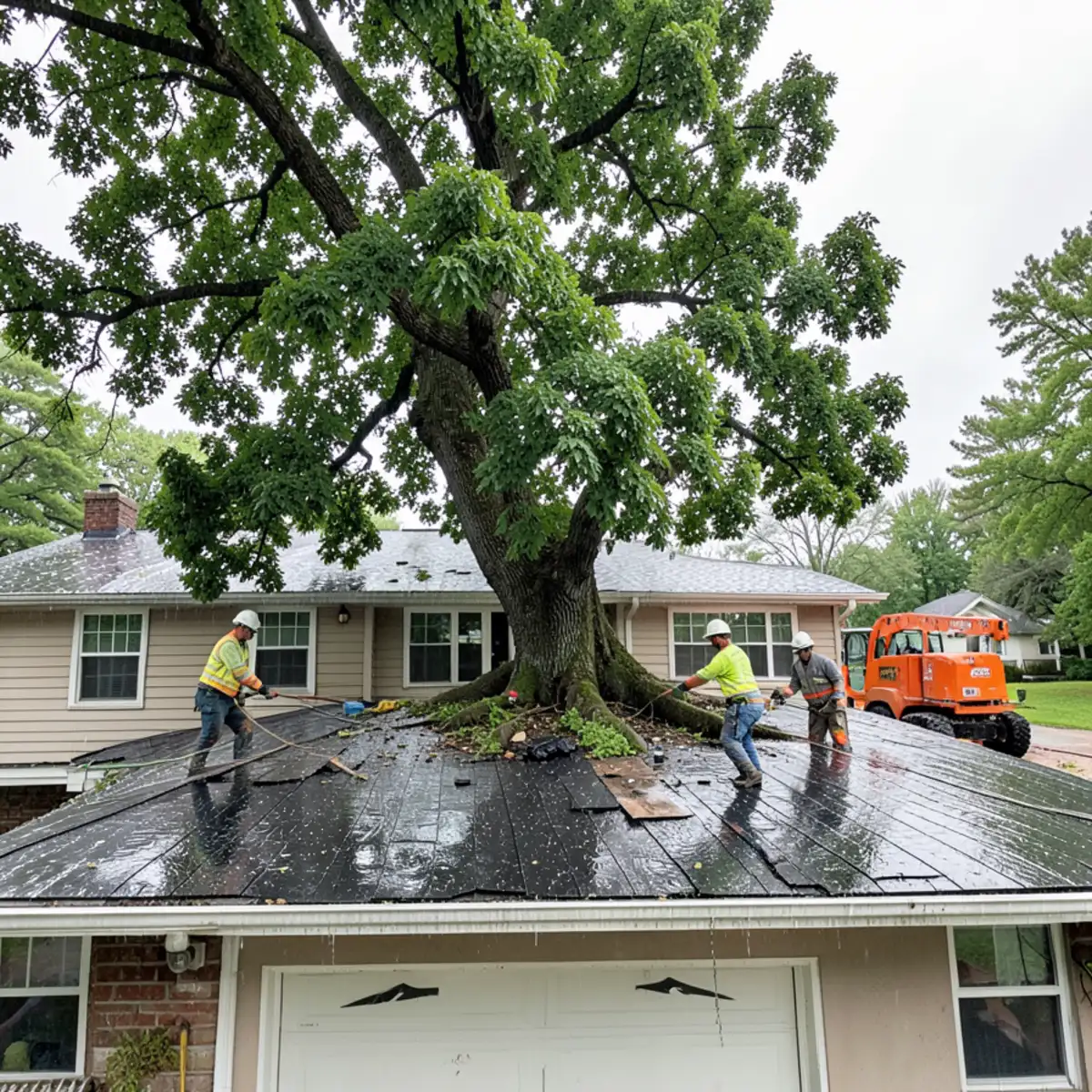
If a tree strikes your Lansing house, immediately evacuate rooms beneath the breach, confirm no energized power lines or gas leaks are present, and call 911 if lines are down. Photograph all structural damage before touching debris, then call a crane-equipped tree service and your insurance carrier to stabilize the roof.
The Moment of Impact: Immediate Life-Safety Steps
The sound of an 80-year-old oak or silver maple crashing through a residential roofline in Lansing is unmistakable—a violent shudder followed by the cracking of structural rafters, shattering drywall, and rushing rain. In the immediate aftermath of a tree strike, your adrenaline will spike. How you react in the first twenty minutes dictates whether everyone stays safe and whether your property damage remains contained.
First and foremost: evacuate the immediate impact zone. Move all household members, children, and pets out of rooms located beneath or adjacent to the breached ceiling. Even if the ceiling plaster has not completely caved in, thousands of pounds of timber may be resting precariously on cracked roof trusses. A sudden wind gust or shifting branch can trigger a secondary ceiling collapse without warning.
Do not climb onto the roof to inspect the damage, and never send anyone into the attic while the trunk remains unsupported. In Lansing's historic districts like Moores Park, Westside Neighborhood, and Colonial Village, steep roof pitches combined with wet leaves, moss, and structural instability make roof surfaces treacherous.
Critical Utility Alert
If you detect the sulfurous smell of natural gas, hear hissing around exterior meters, or see sparks from severed utility lines, evacuate the entire house immediately. Call 911 from a safe distance, followed by Consumers Energy (gas) and Lansing Board of Water & Light (BWL).
Dealing with a Hazardous Tree in Lansing?
Call Total Tree Maintenance directly at (321) 677-9055 for immediate guidance and scheduled on-site estimates.
Lansing Hub
3105 S MLK Jr Blvd
Transparent Pricing
Free Itemized Written Scope
Safety First
ANSI Z133 & MISS DIG 811
Storm Ready
Fast Local Crew Dispatch
Step 2: Inspecting for Energized Power Lines
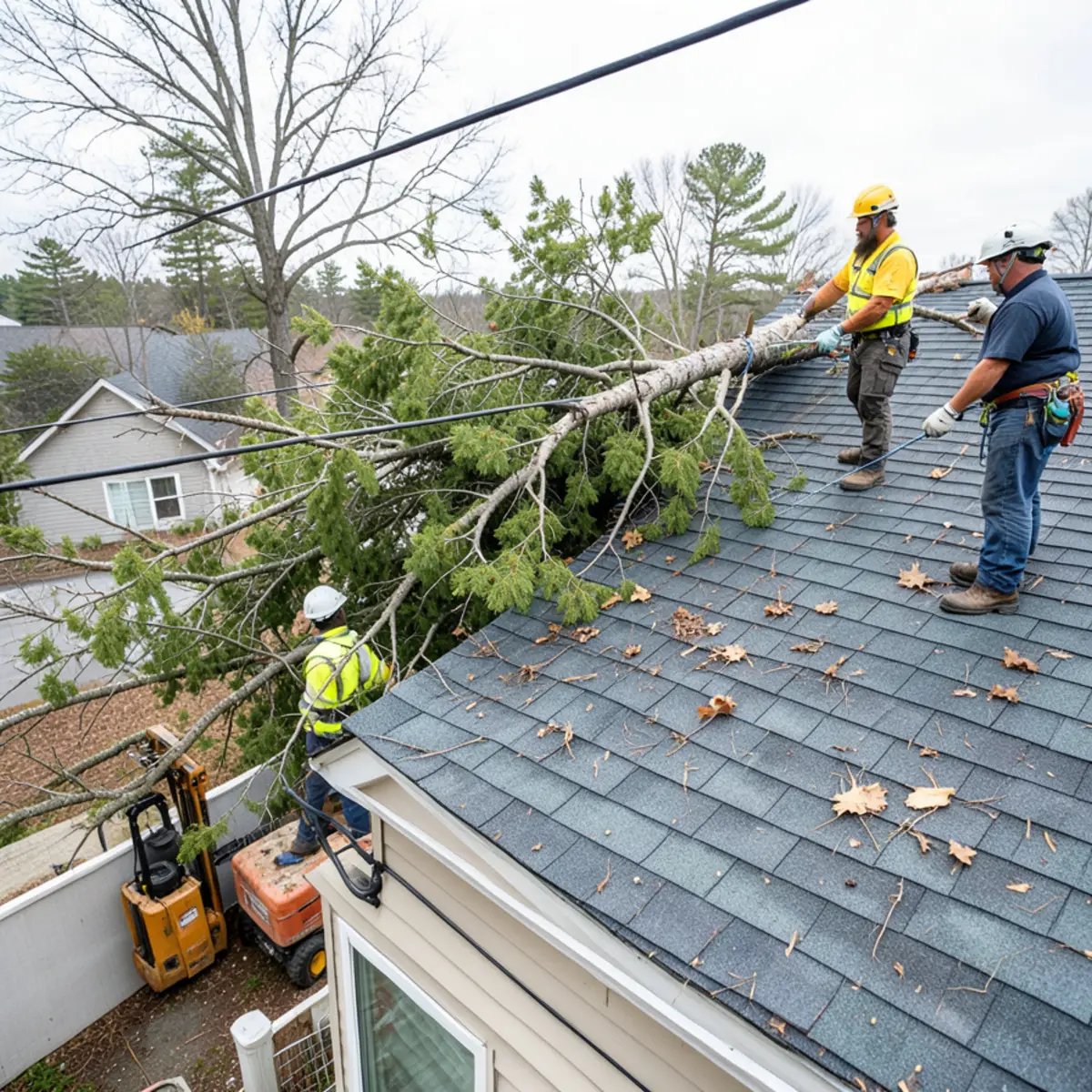
In older Lansing neighborhoods—such as Old Town, Colonial Village, REO Town, and Moores Park—overhead secondary service drops cross closely through mature backyard tree canopies. When a tree fails, it frequently tears down electrical lines or pins energized conductors against wet tree limbs, aluminum gutters, or chain-link fences.
Under OSHA standard 29 CFR 1910.333, work within 10 feet of energized electrical conductors is strictly restricted to qualified utility personnel. Never attempt to inspect or cut tree branches yourself if overhead wires are down or tangled in the canopy. Treat all downed lines as live and deadly. Call Lansing Board of Water & Light (BWL) at (877) 295-5001 or Consumers Energy at (800) 477-5050 to report downed lines and request an emergency service disconnect.
Even if power appears out on your block, automatic reclosers or neighborhood backup generators can re-energize fallen lines without warning. Maintain a minimum safe clearance distance of at least 35 feet from any downed wire on wet soil or asphalt until a utility lineman confirms the circuit is de-energized and grounded.
Step 3: Documenting Structural Damage for Your Insurer
Before any tree crew begins cutting timber, thorough photographic and video evidence is essential for your homeowners insurance claim. Insurance adjusters require clear documentation proving that the tree’s impact was the direct and primary cause of structural penetration.
Take comprehensive wide-angle photos from the ground showing the entire tree, its root base, the point of impact on the roof, damaged gutters, crushed siding, and broken windows. If you can safely access the attic or second floor without standing under sagging rafters, capture photos of ceiling fissures, cracked roof decking, and active water leaks. Keep all documentation organized for your claims adjuster.
Capture high-definition video walking slowly around the perimeter of the property, narrating the date, time of the storm, and observable impact points. Close-up photos of broken rafter ties, severed electrical conduits, and buckled fascias provide vital technical evidence that prevents claim depreciation.
| Documentation Item | Recommended Capture Angle | Insurance Purpose |
|---|---|---|
| Wide Property Overview | From street or opposite yard | Proves overall storm context and tree trajectory. |
| Point of Roof Impact | Elevated ground view showing rafters | Demonstrates structural penetration through shingles and decking. |
| Root Base / Trunk Split | Close-up of root flare or trunk union | Verifies weather-induced failure (not pre-existing felling). |
| Interior Water Infiltration | Drywall stains, buckets, floor pooling | Supports secondary interior water damage claim allowance. |
| Overhead Utility Damage | Service drop connection at weatherhead | Documents mechanical detachment of electrical infrastructure. |
Step 4: Mobilizing an Emergency Tree Service & Crane Crew
Do not hire an unvetted door-to-door contractor with a pickup truck and a chainsaw to cut a tree off your roof. If a tree trunk resting on structural trusses is improperly sectioned, the remaining timber can violently roll, punch through interior ceilings, or destabilize load-bearing walls.
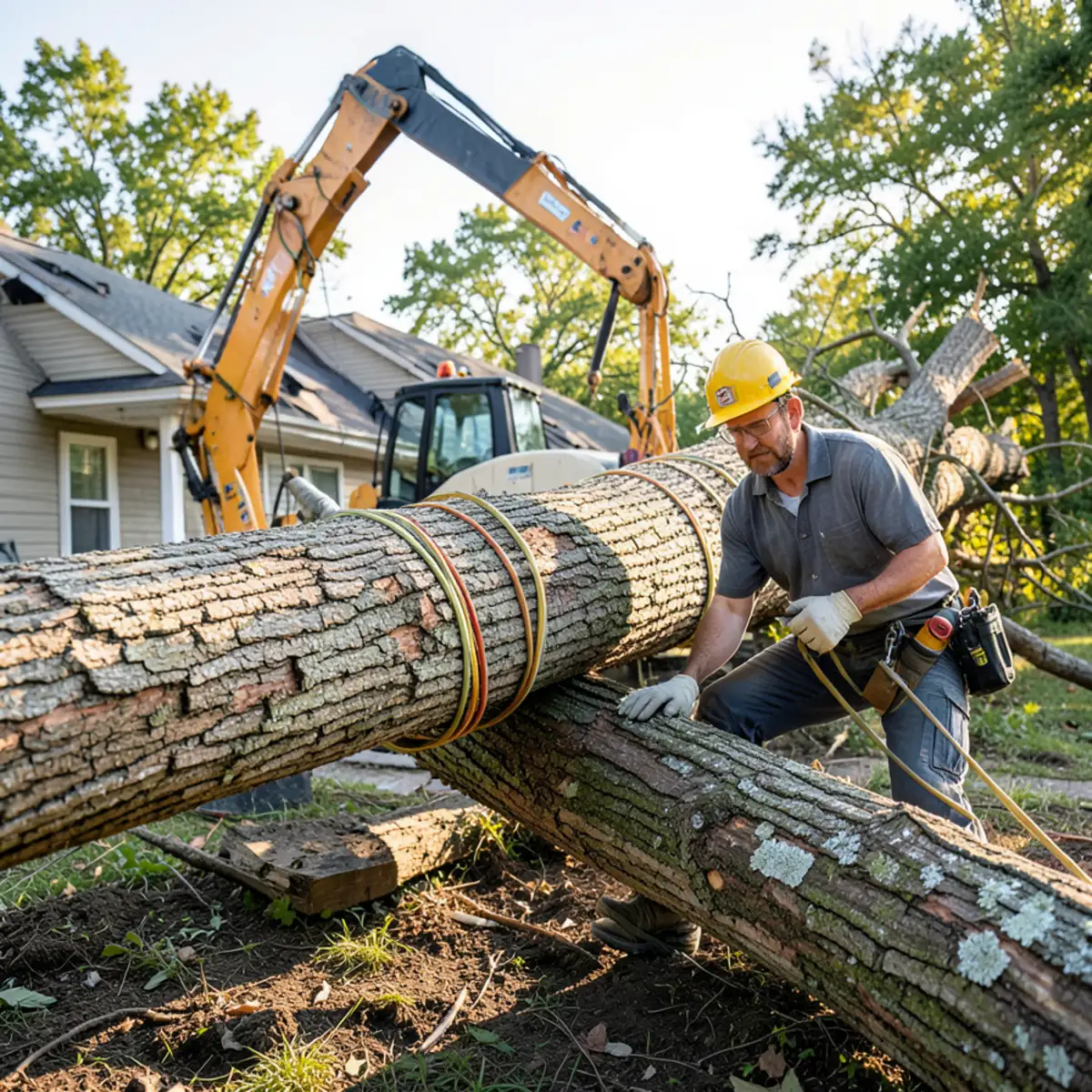
Total Tree Maintenance utilizes mobile hydraulic cranes and precision rigging straps for structural tree extractions. Our arborist secures the tree's center of gravity to the crane hook before any saw cuts are made. The crane then lifts the timber straight up into the air, transferring the load off your roof framing without lateral friction or secondary impact.
Our crane-assisted removal protocols comply fully with ANSI Z133 arboricultural safety standards. By lifting vertical loads straight off rafters, we prevent secondary structural collapses, chimney shearing, and gutter tearing that commonly happen when inexperienced operators attempt ground-felling cuts on load-bearing storm wood.
Step 5: Emergency Roof Tarping & Temporary Weatherproofing
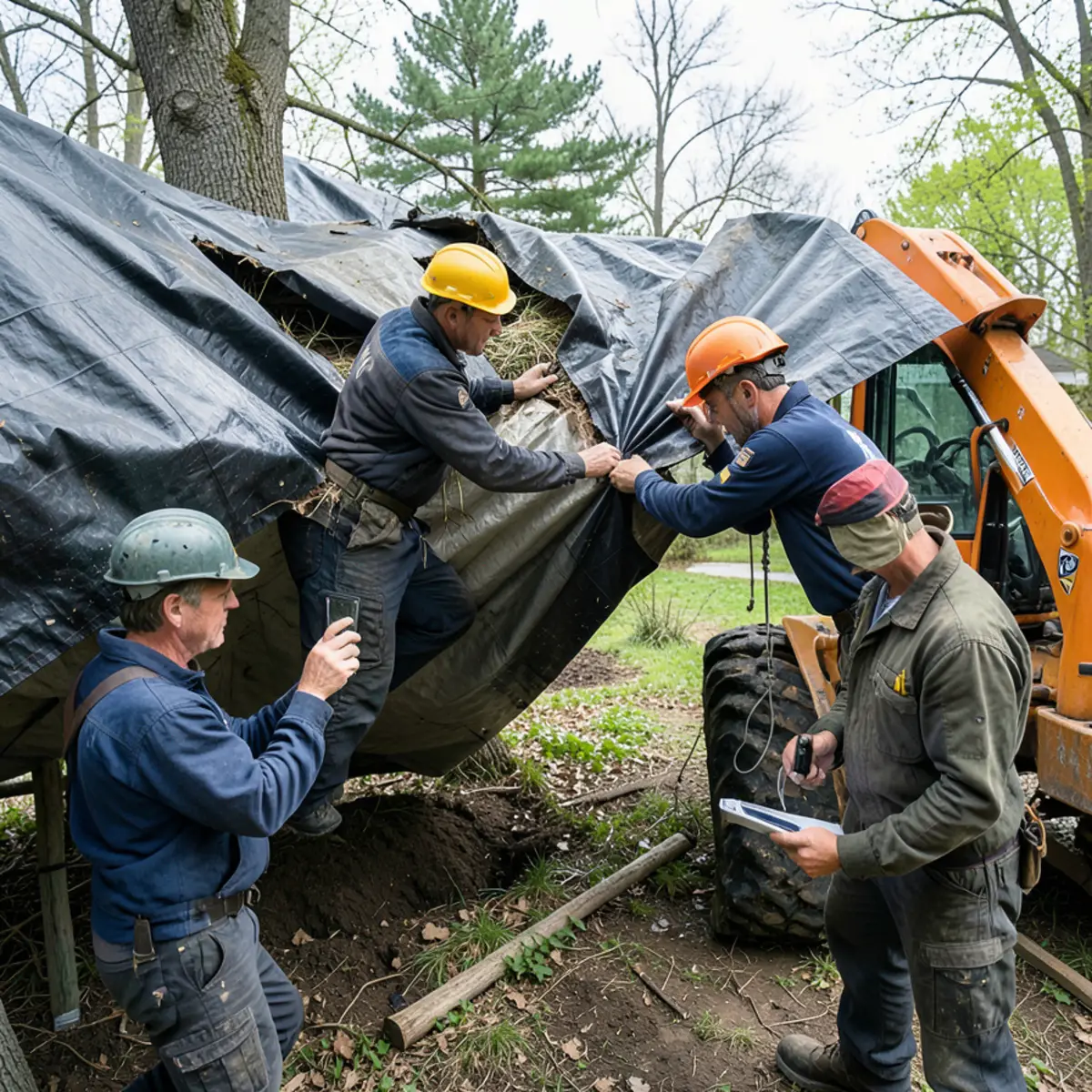
Once the heavy timber is lifted clear of your home, exposed roof holes must be sealed against rain and snow immediately. A sudden downpour through a punctured roof can ruin ceiling insulation, short out electrical circuits, and saturate hardwood floors.
Our emergency crews carry heavy-duty industrial poly tarps, dimensional lumber battens, and fasteners. We securely anchor waterproof tarps over all breached roof surfaces, providing a durable temporary weather barrier while you await insurance adjuster review and permanent roofing contractor repairs.
We never nail tarps directly into undamaged shingles; instead, we build batten frames anchored with furring strips along the ridge and eaves. This guarantees water sheds cleanly over the valley flashings without creating hundreds of secondary nail leaks across intact sections of your roofing substrate.
Expert Insight: Real Trade-Offs in Structural Timber Rigging
When a multi-ton tree rests on a residential roof in Ingham County, homeowners often wonder why tree services cannot simply take a chainsaw and start cutting off branches from the top down. Understanding the physics of stored kinetic energy reveals why that approach is hazardous.
Branches pinning a roofline are under intense compression and tension. In the tree industry, this is known as reaction wood. Cutting a compression-loaded branch without dynamic counter-weighting causes the limb to spring back like a catapult. Even worse, removing branch weight from one side of the trunk can shift the trunk's center of mass, causing the main stem to pivot, roll, and plunge straight through the roof joists into the living room below.
While mobilizing a hydraulic crane and specialized rigging crew represents a higher mobilization cost than a basic bucket truck, it eliminates the unpredictable release of kinetic energy. The crane hook bears 100% of the branch weight before the saw teeth touch the bark. The trade-off is clear: precision crane extraction protects the structural integrity of your home and prevents tens of thousands of dollars in secondary rebuild costs.
Lansing Homeowner Post-Impact Recovery Checklist
Navigating the first 48 hours after a tree hits your house requires systematic execution. Follow this field-tested checklist developed by our Lansing emergency response team to protect your family and your insurance claim:
- 1. Verify Life Safety: Evacuate rooms beneath the impact and account for all occupants and pets away from compromised structural ceilings.
- 2. Check Utility Lines: Visually inspect service drops; call BWL (877-295-5001) or Consumers Energy (800-477-5050) immediately if wires are downed or sparking.
- 3. Open Your Insurance Claim: Call your insurer's 24-hour claims line, state that an emergency fallen tree has struck the dwelling, and receive your claim number.
- 4. Document Before Disturbing: Take 20+ photos and video clips showing ground angles, root tear-outs, roof rafter penetration, and interior water leaks.
- 5. Request Professional Rigging: Contact Total Tree Maintenance at (321) 677-9055 for emergency crane extraction, structural stabilization, and heavy-duty poly roof tarping.
- 6. Secure Certificate of Insurance (COI): Confirm your tree contractor carries at least $1,000,000 in general liability and workers' compensation coverage.
- 7. Coordinate with Roofing Contractor: Once timber is safely removed and tarped, schedule a licensed builder or roofing specialist for structural truss repair.
Lansing Permitting & City Code Coordination for Storm Damage
Under the City of Lansing Code of Ordinances §688.01, property owners are generally responsible for maintaining trees on their private parcels. However, when an emergency tree failure poses an imminent hazard to life, safety, or structural dwellings, emergency stabilization can proceed immediately without waiting for standard permit review cycles.
If the fallen tree originated in the municipal right-of-way between the sidewalk and curb, the City of Lansing Forestry Division must be notified. Our dispatch staff frequently coordinates with city forestry inspectors, BWL line-clearing superintendents, and Ingham County emergency services to ensure safe right-of-way clearing while prioritizing the homeowner's roofline integrity.
Frequently Asked Questions
Frequently Asked Questions
Clear answers regarding local Lansing permit rules, tree removal costs, and emergency response.
Yes, in most cases. If an otherwise healthy tree falls during a storm and strikes an insured building (your house, detached garage, or shed), your Michigan homeowners insurance policy typically covers the cost of professional tree removal off the structure as well as structural repairs, minus your deductible.
Field operations crew based at 3105 S Martin Luther King Jr Blvd, Ste B, Lansing, MI. Specialists in hazardous tree removals, emergency storm recovery, ANSI A300 pruning protocols, and municipal tree codes throughout Ingham, Eaton, and Clinton counties.
Related Tree Services & Areas
Have Questions About Your Trees?
Our Lansing-based team provides honest evaluations and free on-site estimates. Call (321) 677-9055 today.
Lansing Hub
3105 S MLK Jr Blvd
Transparent Pricing
Free Itemized Written Scope
Safety First
ANSI Z133 & MISS DIG 811
Storm Ready
Fast Local Crew Dispatch