
Direct Answer / Quick Summary
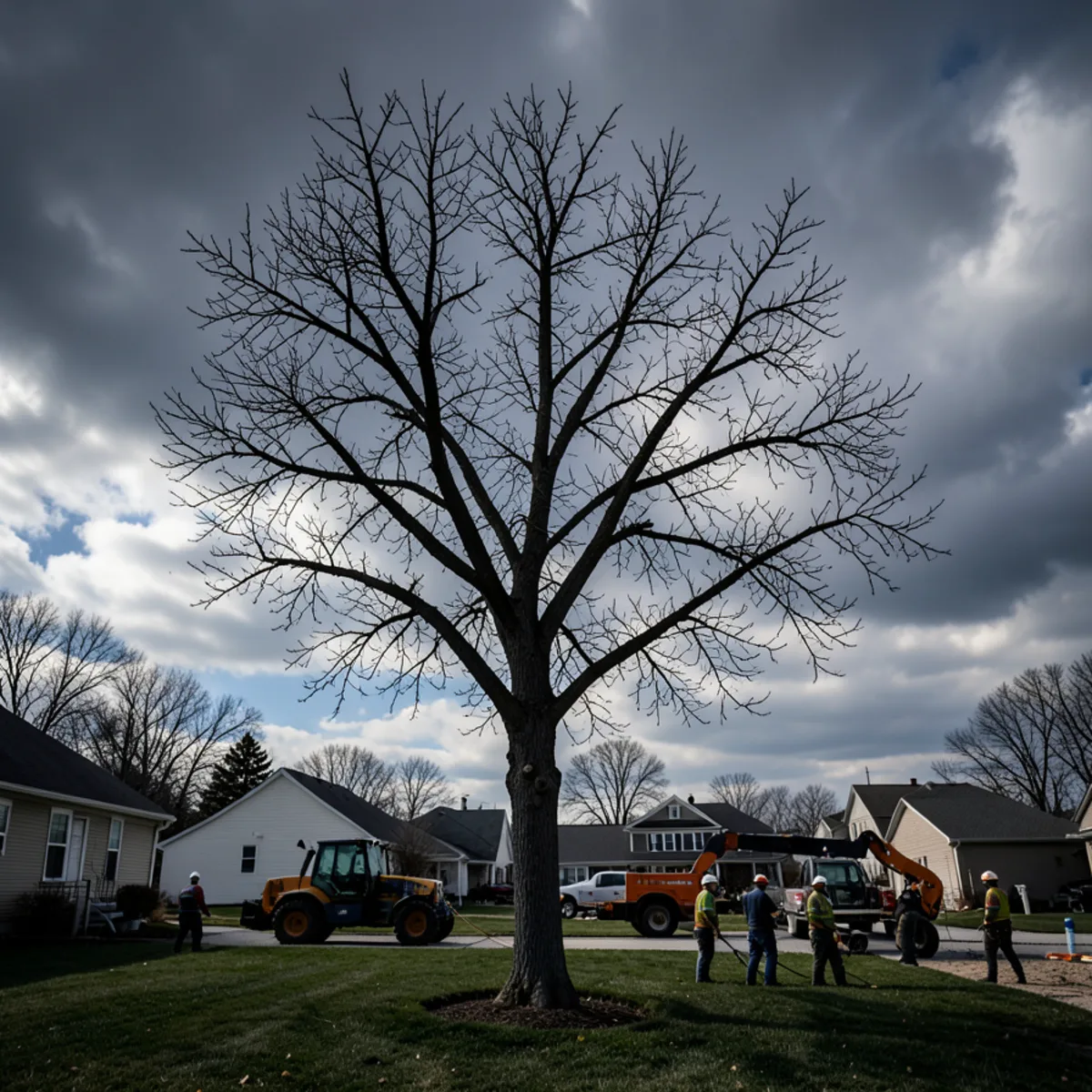
Dead ash trees in Lansing must be removed promptly because emerald ash borer larvae girdle the vascular system, causing rapid cellular drying and severe wood brittleness. Standing dead ash shatters unpredictably under wind or on calm days, increasing rigging hazard, equipment costs, and property liability.
The Legacy of Emerald Ash Borer in Greater Lansing
The Emerald Ash Borer (*Agrilus planipennis*), an invasive wood-boring jewel beetle native to northeastern Asia, was first identified in North America in southeastern Michigan in the summer of 2002. From there, it spread rapidly across the Grand River and Red Cedar basins, devastating millions of green ash (*Fraxinus pennsylvanica*) and white ash (*Fraxinus americana*) trees across Ingham, Eaton, and Clinton counties.
According to Michigan State University (MSU) Extension forestry reports, municipal forestry crews in the City of Lansing were forced to remove more than 5,000 infested public street and park ash trees—roughly half of the city’s municipal ash canopy. However, on private residential properties across Lansing, East Lansing, Holt, and Okemos, thousands of dead ash trees were never removed and remain standing today.
Dealing with a Hazardous Tree in Lansing?
Call Total Tree Maintenance directly at (321) 677-9055 for immediate guidance and scheduled on-site estimates.
Lansing Hub
3105 S MLK Jr Blvd
Transparent Pricing
Free Itemized Written Scope
Safety First
ANSI Z133 & MISS DIG 811
Storm Ready
Fast Local Crew Dispatch
The Science of Internal Brittleness: Why Dead Ash Snaps
Many property owners assume that a dead tree can stand harmlessly for years like a telephone pole. With ash trees, this assumption is dangerous. Emerald ash borer larvae feed exclusively in the phloem and outer xylem—the vascular transport tissue directly beneath the bark.
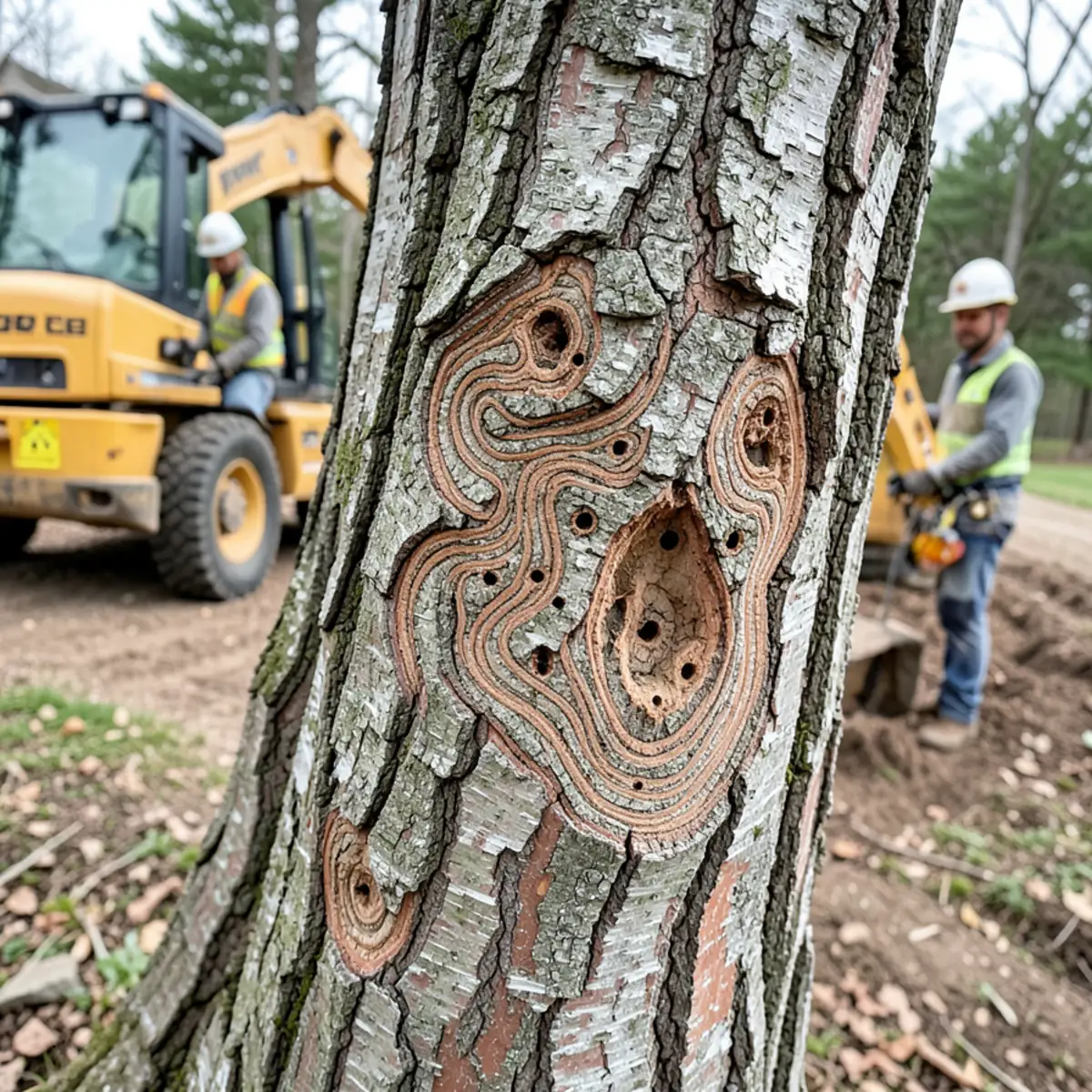
As millions of larvae etch their characteristic S-shaped galleries through the wood, they sever the tree’s ability to circulate water and nutrients. Once the tree dies, the wood dries out at an accelerated rate compared to other hardwoods. Without moisture, ash timber loses its structural elasticity and cell wall cohesion, becoming exceptionally brittle. Instead of bending under wind loads, dead ash branches shatter suddenly with clean, glassy fractures, dropping heavy limbs even on calm, sunny days.
Why Waiting to Remove a Dead Ash Increases Your Costs
Delaying the removal of a dead ash tree is a false economy. In the arboricultural industry, dead ash trees are widely recognized as the most hazardous trees to dismantle. The longer an ash tree stands dead, the more expensive it becomes to remove safely:
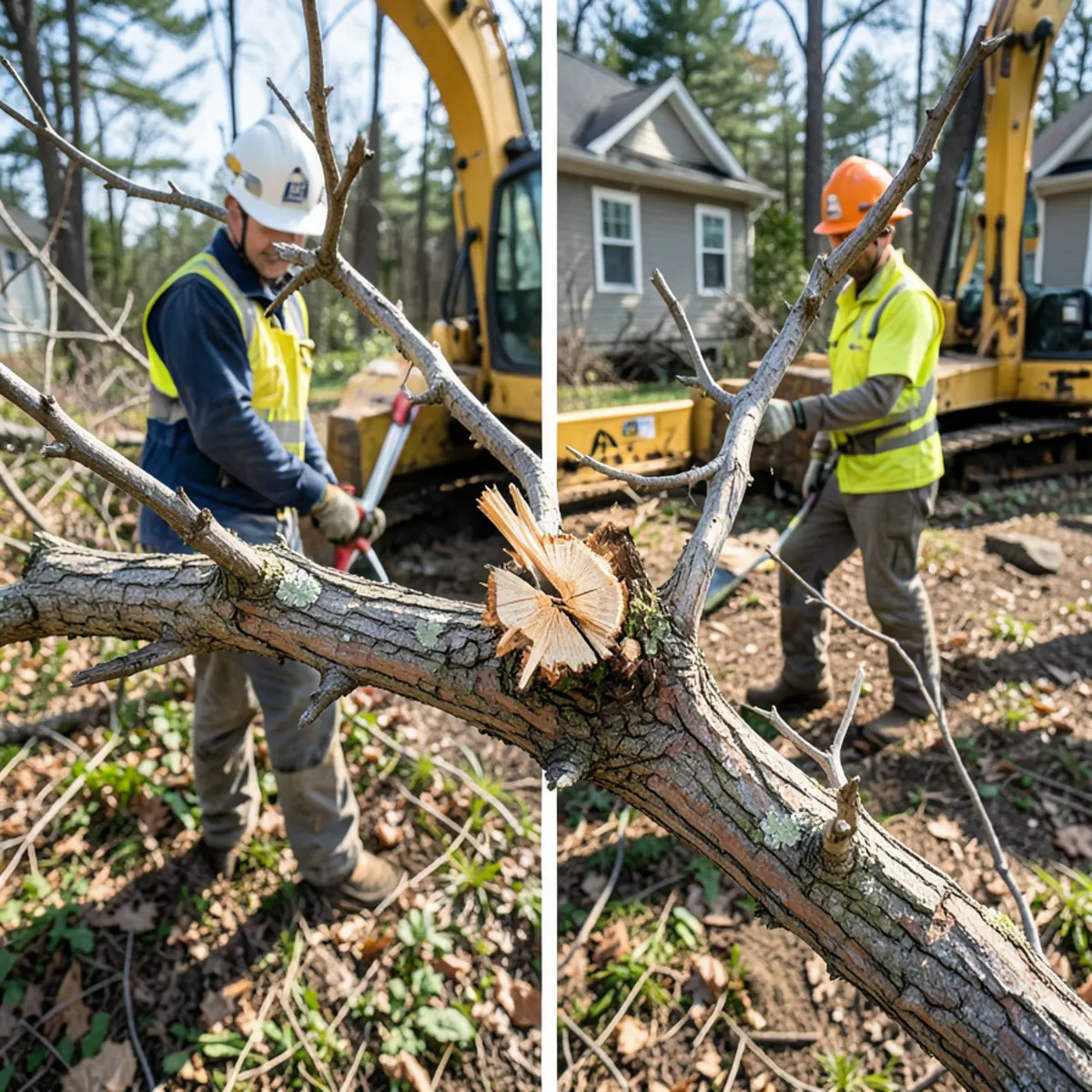
- Loss of Climbing Tie-In Points: When a tree dies, structural rot penetrates the upper branch forks within two to three seasons. Arborists can no longer safely climb the tree using standard ropes and saddles because the limbs cannot bear a climber’s weight.
- Mandatory Crane Deployment: When a tree is too weak to climb and cannot be accessed with a standard bucket truck, the only safe removal method is deploying a commercial hydraulic crane. The crane supports the climber aloft and hoists severed sections vertically, adding equipment costs to the project.
- Root Collar Failure Risks: Fungal saprophytes rapidly colonize the dead root system beneath the soil line. An ash tree that looks intact above ground may have rotting roots, making it susceptible to whole-tree blowdown during moderate storms.
- Fence and Roof Target Damage: A brittle ash limb that breaks and punctures a garage roof or crushes an ornamental fence adds costly structural deductible expenses to your plate.
Expert Insight: Why Traditional Hinge Felling Fails on Dead Ash
In standard forestry and green-tree removals, tree cutters rely on directional felling using a notch cut and a back cut. The thin ribbon of wood left between these cuts—the hinge—acts like a heavy door hinge, steering the trunk along a planned trajectory to the ground. On dead ash trees, however, this basic physics principle collapses.
Because emerald ash borer feeding destroys the wood's vascular fibers, dead ash timber possesses almost zero tensile strength. When a chainsaw operator cuts into a dead ash trunk, the brittle hinge wood often snaps prematurely before the back cut is finished. This triggers two catastrophic failure modes: either a sudden barber-chair (the trunk splits vertically upward under compression, striking the operator), or the tree pivots unpredictably sideways, crashing into nearby homes, power lines, or fences.
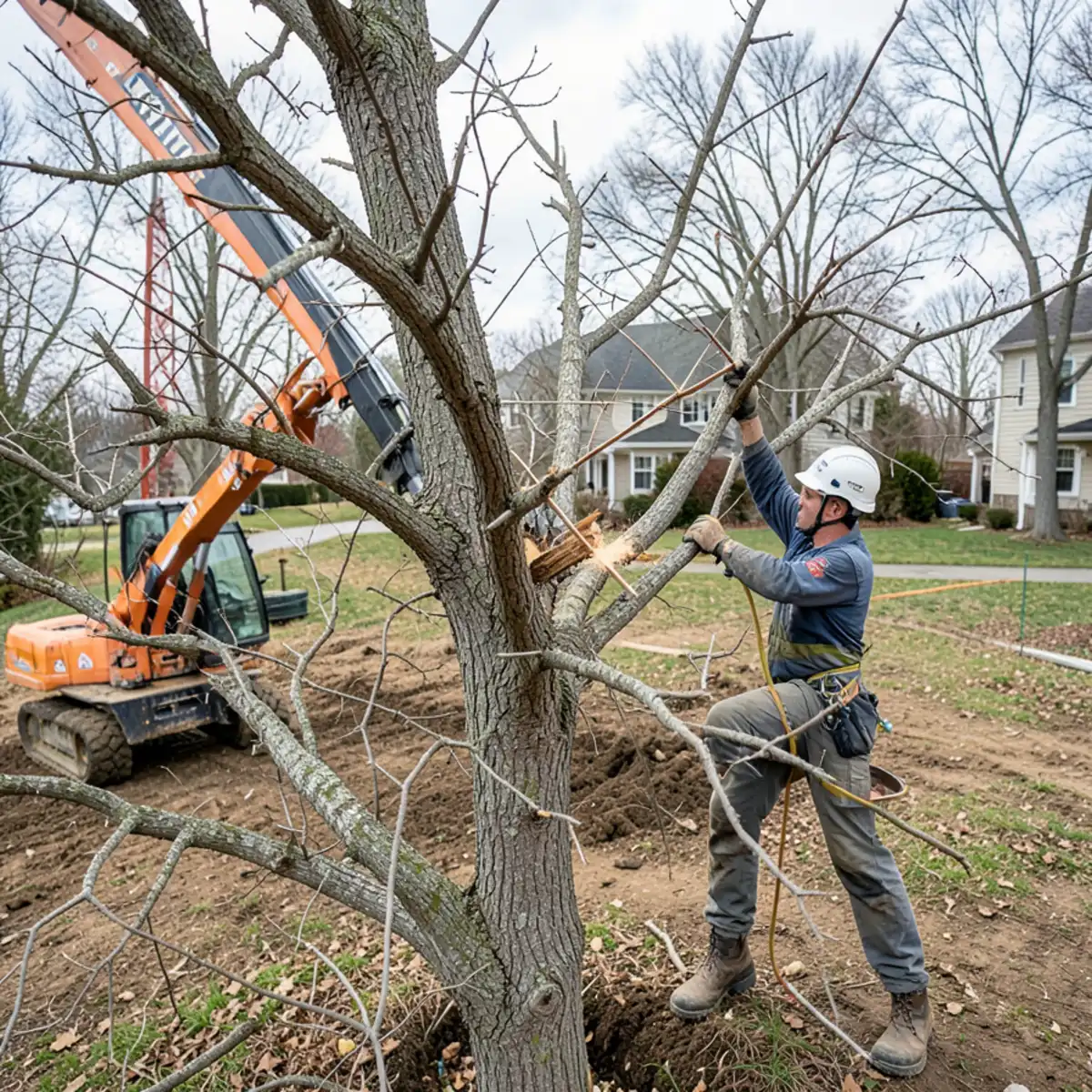
For this reason, Total Tree Maintenance strictly enforces non-shock rigging protocols on all brittle ash trees across Lansing. We use mobile crane hookups or articulated aerial lifts to support the top of each timber segment before cutting, eliminating dependence on compromised hinge wood entirely.
How to Confirm If an Ash Tree on Your Lot Is Dead
If you have a mature shade tree on your property and are unsure whether it is an ash or whether it is salvageable, look for these distinctive botanical and insect indicators:
| Diagnostic Sign | What to Look For | Arboricultural Significance |
|---|---|---|
| D-Shaped Exit Holes | 1/8-inch flat-topped D-shaped holes in bark | Confirms adult emerald ash borer emergence. |
| S-Shaped Larval Galleries | Serpentine channels packed with sawdust under bark | Shows vascular girdling by feeding larvae. |
| Canopy Thinning & Epicormic Shoots | Upper branches bare; dense suckers sprouting at trunk base | Classic stress response of a dying ash tree. |
| Woodpecker Flaking ('Flecking') | Outer bark chipped away by birds exposing light patches | Woodpeckers actively hunting borer larvae in wood. |
Michigan Premises Liability & Negligence Law for Dead Trees
Many Lansing homeowners believe that if a storm blows down a tree from their yard onto a neighbor's garage, it is automatically an 'Act of God' handled entirely by the neighbor's insurer. Under Michigan premises liability common law, this protection only applies to healthy, living trees.
If a dead ash tree has stood visibly leafless and decaying for two or more growing seasons, the property owner is legally deemed to have 'constructive notice' of an open and obvious hazard. If that unmaintained tree subsequently falls on a neighbor's house, automobile, or utility connection, the neighbor's insurance carrier will frequently subrogate the claim, pursuing the tree owner directly for full damages and legal costs based on proven property owner negligence.
Safe Removal Protocols for Brittle Lansing Ash
At Total Tree Maintenance, our crews specialize in low-impact takedowns of hazardous dead ash across Mid-Michigan. We never attempt dangerous felling on compromised wood. We utilize aerial lifts and mobile crane picks to secure the timber from above, lowering sections gently to ground crews without shock-loading fragile limbs.
Once the tree is on the ground, our high-capacity chipper processes the limbs into mulch, and our commercial stump grinders eradicate the remaining root flare. If you have standing dead ash on your property, call us at (321) 677-9055 for an honest, on-site hazard assessment.
Frequently Asked Questions
Frequently Asked Questions
Clear answers regarding local Lansing permit rules, tree removal costs, and emergency response.
Tree injections (such as emamectin benzoate) can protect healthy ash trees or trees with less than 30% canopy dieback. However, once an ash tree has lost more than 30 to 50% of its canopy, structural vascular damage is irreversible, and chemical treatment is no longer effective. Removal is the only safe option.
Field operations crew based at 3105 S Martin Luther King Jr Blvd, Ste B, Lansing, MI. Specialists in hazardous tree removals, emergency storm recovery, ANSI A300 pruning protocols, and municipal tree codes throughout Ingham, Eaton, and Clinton counties.
Related Tree Services & Areas
Have Questions About Your Trees?
Our Lansing-based team provides honest evaluations and free on-site estimates. Call (321) 677-9055 today.
Lansing Hub
3105 S MLK Jr Blvd
Transparent Pricing
Free Itemized Written Scope
Safety First
ANSI Z133 & MISS DIG 811
Storm Ready
Fast Local Crew Dispatch